23.7.12

Never Let a Fact Get in the Way

I must admit that for several years I have had ABC News in my bookmarks for daily news checking, but in the aftermath of the Aurora tragedy, I had to remove them because I simply don’t know what’s true and what’s false from them anymore.

First they claimed that the shooter was a member of the Tea Party when in fact he had no ties to the Tea Party whatsoever. Now it’s been revealed that when ABC claimed the shooter’s mother told them that “[they] have the right person,” meaning specifically James Eagan Holmes, she actually used the phrase after they asked her if she was the mother of James Holmes in Aurora, Colorado. She had no idea what had even happened when she used the phrase so she was not, in fact, saying it regarding the shooting.

It appears that ABC News is more concerned with juicing up stories with salaciousness as well as getting a quote — any quote — first, even if that means using an answer for one question as an answer to a question that was never even posed.

If I want falsehoods, I’ll just stick with The Onion. At least there’s a bit of humor to go along with the untruths.

3.7.12

Short on Credit

YouTube is now a human who can take snazzy photos and record videos.
I’m noticing more and more that media outlets are having a difficult time figuring out how to give credit to photographers and videographers when their work is used in a news story and is found elsewhere on the Internet.

Apparently it’s now the common thing to give credit to the hosting Website instead of credit to the photographer or videographer.

A few weeks ago I saw a story about a woman whose Facebook profile photo was used in the story and the reporter credited Facebook as having taken the photo. Really? Facebook is now a person who takes photos? Where is Mr. Facebook and how do I contact him for portraits?

Today the WPTV Web Team—I’m not sure if that’s like the A-Team or something—is crediting YouTube as having been the videographer of a man who went on a naked ninja rampage in Indianapolis. The video looks as though it had been recorded by a person on the street, but the credit goes to a Website as having been the one behind the actual recording. Perhaps Mr. YouTube and Mr. Facebook should get together and work on a project.

All sarcasm aside, Websites don’t take the photos and record the videos—people do. Please give credit to those who took the time to do the photography or videography—not the Website that just happens to host it.

10.12.11

Let Love Ring


Imagine if we all wore the same clothes every day. Imagine if we all drove the same vehicle. Imagine if we all listened to the same music. It would be a quite boring life, wouldn’t it?

Can such a situation happen? Possibly.

I’m a big supporter of people being able to do their own thing so long as they’re not harming others physically, financially, or emotionally. I’m also a big supporter of variety and the concept of being open to new ideas. Knowing that we have a big world out there and knowing that such a situation lends itself to having diversity in life means that we have more to enjoy.

For example, as I’m writing this I’m listening to Frank Sinatra. Later today I might find myself listening to Slayer or Anthrax. Tomorrow I might find myself listening to Wagner, Bach, or Tchaikovsky. There’s nothing even remotely similar to any of these artists, but I can enjoy all of them. It’s the antithesis of cultural homogenization.

One thing that I’ve seen become more and more culturally homogenized is that of relationships, weddings, and marriage in general. Specifically, hearing people say that a “real” engagement ring or a “real” wedding ring must have a diamond in it has become a standard talking point for many.

My contention is that an engagement ring or wedding ring is whatever the people in question determine it to be—not what the diamond industry says it should be.

What’s interesting is that there’s nothing “traditional” about diamonds being part of marriage. In fact, diamonds were never even part of the topic until the 1930s, when the DeBeers diamond company told Americans that a diamond ring—ostensibly sold by them—was required to show love. Americans bought it, hook, line and sinker. In 2007, Meghan O’Rourke wrote a piece for Slate in which she discusses the history of the diamond wedding ring (I hope that it doesn’t cause an issue to reprint one paragraph from her piece for reference purposes only). Ms. O’Rourke writes:

In 1919, De Beers experienced a drop in diamond sales that lasted for two decades. So in the 1930s it turned to the firm N.W. Ayer to devise a national advertising campaign—still relatively rare at the time—to promote its diamonds. Ayer convinced Hollywood actresses to wear diamond rings in public, and, according to Edward Jay Epstein in The Rise and Fall of the Diamond, encouraged fashion designers to discuss the new “trend” toward diamond rings. Between 1938 and 1941, diamond sales went up 55 percent. By 1945 an average bride, one source reported, wore “a brilliant diamond engagement ring and a wedding ring to match in design.” The capstone to it all came in 1947, when Frances Gerety—a female copywriter, who, as it happened, never married—wrote the line “A Diamond Is Forever.” The company blazoned it over the image of happy young newlyweds on their honeymoon. The sale of diamond engagement rings continued to rise in the 1950s, and the marriage between romance and commerce that would characterize the American wedding for the next half-century was cemented. By 1965, 80 percent of American women had diamond engagement rings. The ring had become a requisite element of betrothal—as well as a very visible demonstration of status. Along the way, the diamond industry’s guidelines for the “customary” cost of a ring doubled from one month’s salary to two months’ salary.

Yes, you read that correctly: a diamond company helped to convince Americans en masse that in order to show your love for your wife, you had to make them, the diamond companies, rich. The best part is that Americans have gone along with the idea for about four generations.

I don’t write this to convince people to not purchase a diamond ring to signify love; I write it to convince people to be willing to see that an engagement ring or a wedding ring is nothing more than a symbol of something that has been defined by the people involved—not by a cultural trend that was paid for by an industry which profits from that trend.

When I hear people say that a ring cannot be a “real” engagement ring or a “real” wedding ring if it doesn’t have a diamond in it, it worries me that we might be positioning ourselves culturally to become slaves to whatever the next advertising blitz might be. It also worries me that people aren’t deciding for themselves what their own sign of love is. They turn to an ad agency to decide for them.

I personally don’t need to pay a diamond company three months of salary—yes, I’ve been told that the cost has now reached three months of pay instead of two—to show my girlfriend that I love and respect her. Some people might feel that need, but in the end the question becomes: Are you doing it to show love or are you doing it to show off your perceived level of social status?

I have no problem saying that I’m more interested in keeping my symbols of love on a personal level as opposed to making it known publicly by way of spending $6,000 on a piece of compressed coal.

And oddly enough, it cost me nothing to publicly state right here that I love and respect my girlfriend.

I’d sooner have my words and actions be forever.

18.8.11

Not Your Type - Part II...or III


Reuters’ Jessica Dye is reporting that attorney Frank Martinez, who previously sued NBC in 2009 for “no less than $2 million” and then again just a few weeks ago for $1.5 million over alleged typeface/font licensing violations, is now filing a lawsuit of “at least $2 million in damages” on behalf of Typotheque VOF, which is a Dutch type foundry. The suit is being filed against a consulting company which designed Rick Santorum’s Website and the designer is being accused of “illegally using its trademarked font” by Typotheque VOF. The suit also claims that an “unauthorized derivative version” (my emphasis) was used on the Website.

Similar to the $1.5 million Harry Potter font lawsuit from a few weeks ago, this one should be worth watching because of the use of so many typefaces in our technology-driven culture. The Harry Potter suit appeared to focus primarily on licensing and the use of the software; this Santorum suit seems to be both license issues as well as alleged trademark infringement. The part that I’m curious about in this one is the “derivative version” part, since it doesn’t say if this means something like a sans-serif version of the typeface in question (FEDRA) or if it means a completely different font that looks similar. If the latter is the case, we’ve already seen in other instances that typefaces can look similar in the United States but they can’t share trademarked names.

To follow any updates on the stories, I’ll try to make a link to Google News. This should update automatically just by clicking it.

Font Lawsuit

UPDATE 9/3/2011
The PDF version of this suit’s complaint suggests that this might be a little different from the Harry Potter and 2009 NBC suits in that this suit appears to claim that the defendant, RaiseDigital LLC, was using the Fedra font without license by utilizing a “calling for” feature in which one Website contacts a separate server to make a typeface appear on the screen without the viewer having to have that particular typeface installed on their computer.

According to the complaint:

Upon information and belief, Defendant converted or caused a third party to convert Plaintiff’s FEDRA Font Software into a format suitable for use as a “Webfont” using the CSS @font-face call, a programming method used to dynamically call for the serving of font software from a remote server to a viewer’s computer when the viewer has opened a website, in this case, the website known as: www.ricksantorum.com. A showing of the CSS coding “calling” for the downloading and use of unauthorized versions of Plaintiff’s Font Software as a webfont is shown in Exhibit D.

As an example, Blogger currently uses this feature to allow fonts like Allerta, Arimo, Arvo, Copse, Gruppo, Josefin Slab, and the IM Fell fonts to appear on blogs even though these fonts might not be found on the viewer’s computer. A person will be able to view the Website in these typefaces even if they don’t have these font files on their computers because the contacted Website contacts another server to access the font file. The viewer can then see the Website in that particular typeface even if the font file doesn’t exist on their own computer for rendering.

The font file was being accessed even though they were not given authorization to do so, which is stated in the complaint, too:

At the time of the alleged infringements, Plaintiff had not converted the FEDRA Font Software for use as a webfont.

The suit also alleges that other glyphs were added to the FEDRA font software to make an “unauthorized derivative version.” While it will be clear trademark infringement if the extra glyphs are being listed with the trademarked name “FEDRA,” I won’t be surprised to see this particular point questioned by the judge. The glyphs themselves won’t be a point of contention but the use of the FEDRA name will—or rather, should be. Making letters which look similar to other typefaces’ letters is not a crime but attaching them to a trademarked name and using that name is.

Archive.org offers a listing of updates on the case here.

10.8.11

Not Your Type


With all the Harry Potter movie news that has come out over the last few weeks, and all the merchandise that has gone with it, here’s a story that you may have missed in the mix: “NBC Universal Accused of Million-Dollar Harry Potter Font Theft.”

I’m an admitted font/typeface geek, so when I saw this one, it immediately reminded me of a similar lawsuit against NBC two years ago after they were accused of violating end-user licenses from a type foundry called The Font Bureau. At that time, The Font Bureau sued NBC for “no less than $2 million” and said that NBC’s crime was that they copied specific typeface files from one computer to other computers, thus violating the license agreement.

The lawyer for that case, Frank Martinez, is also the attorney involved in the Harry Potter typeface lawsuit. I haven’t been able to find much more on the status of the 2009 Font Bureau case (The Font Bureau, Inc. v. NBC Universal, Inc. et al.) other than a court document site that sells copies of the documents involved. The last line, dated 3/31/2010, reads “Order Dismissing Case.” Is this a sign that the case was dismissed? I’m not sure.


Anyway, both lawsuits create a discussion on what is “owned,” how things are “owned” when it comes to typefaces, and how far a license can go with its requirements for end-users. For instance, if Joe Shmoe creates a typeface and his user license says that you have to use his font only while drinking spiced rum and wearing Spiderman pajamas, do you suddenly open yourself up to a lawsuit if you’re instead drinking hot chocolate and wearing jeans and a T-shirt? More importantly, can you be successfully sued if Joe Shmoe thinks that you’ve used his typeface for a commercial endeavor when Mr. Shmoe’s end-user agreement says that his typeface can’t be used for anything other than personal uses? What if the typeface that Mr. Shmoe claims is his is just a style/design copy permitted by law (not the actual software)?

Aside from the fact that we can attempt to sue anyone for anything (that doesn’t mean that it’ll be successful, of course), when it comes to typefaces, it can be very tricky. Here’s why:

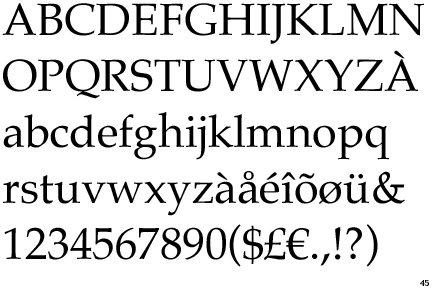
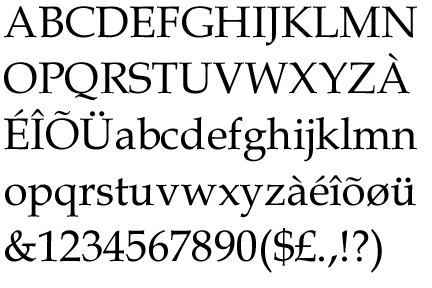
You and I might not agree with it—or you might—but in the United States, a typeface design cannot be trademarked or copyrighted. The typeface’s name and its computer file (the software to make it visible on the screen) can be copyrighted, but the actual design of the letters, numbers, and symbols cannot. For example, if someone makes their own version of Times New Roman and renames their version something like “Another Time” or something similar, they can legally get away with it. (If you don’t believe me, take the time to compare the Palatino typeface with Microsoft’s copy of it called Book Antiqua.)

On attorney Joy Butler’s Website, she discussed a situation in which a client wanted to use a particular typeface for a company logo. It turned out to be a common typeface which had a license allowing it to be used for such purposes and Ms. Butler wrote:

While fonts themselves are not copyrightable, the software that generates fonts and typefaces can be copyrightable. This is the rule of law for the United States only. Fonts may be copyrightable under the laws of other countries.
I quickly concluded that the relevant question for my client was one of licensing.

Here’s what the United States Copyright Office states about typefaces:

Title 37, Part 202: § 202.1 Material not subject to copyright.

The following are examples of works not subject to copyright and applications for registration of such works cannot be entertained:


(a) Words and short phrases such as names, titles, and slogans; familiar symbols or designs; mere variations of typographic ornamentation, lettering or coloring; mere listing of ingredients or contents;


(b) Ideas, plans, methods, systems, or devices, as distinguished from the particular manner in which they are expressed or described in a writing;


(c) Blank forms, such as time cards, graph paper, account books, diaries, bank checks, scorecards, address books, report forms, order forms and the like, which are designed for recording information and do not in themselves convey information;


(d) Works consisting entirely of information that is common property containing no original authorship, such as, for example: Standard calendars, height and weight charts, tape measures and rulers, schedules of sporting events, and lists or tables taken from public documents or other common sources.


(e) Typeface as typeface.


[24 FR 4956, June 18, 1959, as amended at 38 FR 3045, Feb. 1, 1973; 57 FR 6202, Feb. 21, 1992]

And what Title 17, Chapter 1, § 102 of the United States Code says:

The Committee has considered, but chosen to defer, the possibility of protecting the design of typefaces. A “typeface” can be defined as a set of letters, numbers, or other symbolic characters, whose forms are related by repeating design elements consistently applied in a notational system and are intended to be embodied in articles whose intrinsic utilitarian function is for use in composing text or other cognizable combinations of characters. The Committee does not regard the design of typeface, as thus defined, to be a copyrightable “pictorial, graphic, or sculptural work” within the meaning of this bill and the application of the dividing line in section 101.

The part of a typeface that can get you into possible legal trouble is the actual file on your computer that holds the actual letters, numbers, and other assorted figures and symbols (this would be the software which Ms. Butler had mentioned). This appears to be the focus of the NBC lawsuits, but proving this can be tricky, because they’ll have to prove that it was a specific typeface file—in this case, a typeface called Cezanne Regular by the P22 Type Foundry—that was used in violation of its ownership and licensing claims.

For example, going back to the 2009 lawsuit, it would have to be proven that: (1.) the file used in that case was specifically from The Font Bureau; (2.) the typeface used was not a copy of the original design and just given a new name; (3.) the original font file really was copied to other computers and then used. The thing is, the situation changes if the typeface simply looked similar but was actually another typeface. Moreover, there would be no violation whatsoever if an image of the font were created on the one licensed computer and then sent to other computers in the form of an image file (.png, .jpg, etc.) for manipulation. The reason for that is because by doing so, you’ve kept the copyrighted file on the original computer and the other computers would be working with brand new image files. You’ve then bypassed the issue of infringement (remember: the design of the typeface cannot be trademarked or copyrighted but the actual file itself can be copyrighted).

This same situation should be relevant in the current Harry Potter typeface lawsuit. First, was the typeface used really Cezanne Regular by P22 Type Foundry or was it a knock-off by someone else? Second, if the merchandise lettering was made directly from the P22 Type Foundry software, was it made in a way that violated the license agreement? Third, was it used according to the license but then manipulated on another computer to bypass any violation of the license? (In other words, did the licensed computer use the Cezanne Regular file to make an image file that was then sent to another computer for Photoshopping, thus keeping the licensed file on the first computer and the additional computers used nothing more than .jpg, .png or other image files which are not covered under the license?) Or was there some other license violation related to the use of the typeface in commercial products? (This would make little sense because if it were the case, NBC would probably have avoided purchasing the font collection in the first place.)

I’m not completely sure how the attorney in the Harry Potter suit is going to approach this. The Hollywood Reporter story stated that cease-and-desist letters were sent to Hollywood companies over the use of the typefaces on merchandise, but if this is the crux of the lawsuit, it has me confused, since according to the law, the merchandise isn’t in violation of any law or any licensing agreement simply because it has a similar typeface. If their argument is that the typeface files were used in violation of the licensing agreement, then it’s a different story.

Either way, the lawsuits themselves do pose the question: How many lawsuits will now pop up over alleged licensing infringement or copyright infringement via actual typeface files? Will filing suit against people for using certain typefaces—some of which might simply be copies of other typefaces—become commonplace? Will average people now need to be concerned with what typefaces they use on things as mundane as garage sale flyers for fear that someone will see it and say, “I think that might be my font so I’m suing you”?

I must be upfront and say that I’m not a lawyer. I’m a regular joe off the street who is looking at the law through man-on-the-street glasses. I also like using typefaces for fun and for different projects. But I also know how to work within the law.

Now, please excuse me while I put on my Spiderman jammies and have a little spiced rum.

UPDATE - 9/3/11
As a bit of a follow-up on the topic of typefaces and font files versus letter shapes, I wanted to offer some of information that comes directly from Adobe’s frequently-asked-questions page in relation to their anti-piracy initiative.

This is the opening paragraph:

Generally, font software is copyrightable. The font software licensing agreement, also known as the end user license agreement or EULA, is a legally binding contract. If you make an unauthorized copy of font software, you lay yourself and your organization open to severe penalties and criminal proceedings. Even though you can distribute a document that requires a given font to other people, you can only give them a copy of the font you used if they already have a license to use that font and you have confirmed that such a license exists.

As we see, this specifically mentions the font software and not the shape of the letters that make up the typeface as a whole. If we’re creating an image using the font, thus turning the letters of the typeface into something in which the letters cannot be extracted as a font file, we’re then using an image of the original font.

Using the shape of the letter(s)—unless they’re part of a trademarked logo—is far different from distributing the font file or allowing the font to be extracted from the final piece of work, which could easily be viewed as being a form of distribution. This distribution would then violate licensing agreements.

8.8.11

Ashes to Dust

The first time that I laid eyes on the metal behemoth was at night. No, we weren’t visiting the place at night; we had been driving past it on our way to a local amusement park, which was having Halloween-themed night rides. Even in the dark, however, it was easy to see that the place was huge, as it was silhouetted against the starry night sky.

It wasn’t until late December that we found some time to actually check the place out during the day, when the sunlight helped to show just how massive the structure really was.

The St. Nicholas coal breaker is now dead. Well, it’s not actually deceased, since it’s not a living thing, but at one time it was working full-force, a part of Pennsylvania’s anthracite coal industry that helped the area become known as “the coal region.” In fact, many of us from the area have some kind of ties to the industry somewhere in our ancestry.


For quite a few years, the breaker has been empty. There are no sounds until a gust of wind blows through the structure. There are no ghosts in the place save for whatever memories might still exist from any former workers who might still be alive. There is nothing of monetary value left behind, but the items that are still present tell a tale of daily industry: saws, gloves, welding goggles, boots, lathes, nuts and bolts, newspapers, and boxes upon boxes of daily delivery reports.


I kept one of these daily reports to have as a record that things really did take place here. Guys came to work and then went home seven or eight hours later. Some may have stopped by the local bar for a beer or two to unwind from the day; some may have gone straight home to their wives and children.

I also snapped a few photos of the building, knowing that at some point—possibly soon, since several staircases have been removed and “NO TRESPASSING” signs have gone up over the last few weeks—the St. Nicholas breaker will be no more. When the day comes that the breaker is gone, the memories of the place might go, too.

Hopefully the images will remain.